Fees follow transaction size, not value
You pay for data. Five small chunks take more space than one large one, whatever the totals are.
A beginner's breakdown of what your wallet actually holds. There are no coins anywhere — and once that clicks, most of bitcoin's odder behaviour starts making sense.
Almost everyone starts with the same mental picture: a wallet is a container, bitcoin sits inside it, and sending bitcoin moves it from your container to someone else's. It is a reasonable guess and it is wrong in every part, which is why so much of bitcoin seems arbitrary until you replace it.
This page builds the correct picture from the bottom up. It takes about fifteen minutes and it makes everything afterwards easier — why fees behave oddly, why your wallet keeps generating new addresses, why you can restore everything from twelve words, and why sending a small amount sometimes moves your entire balance.
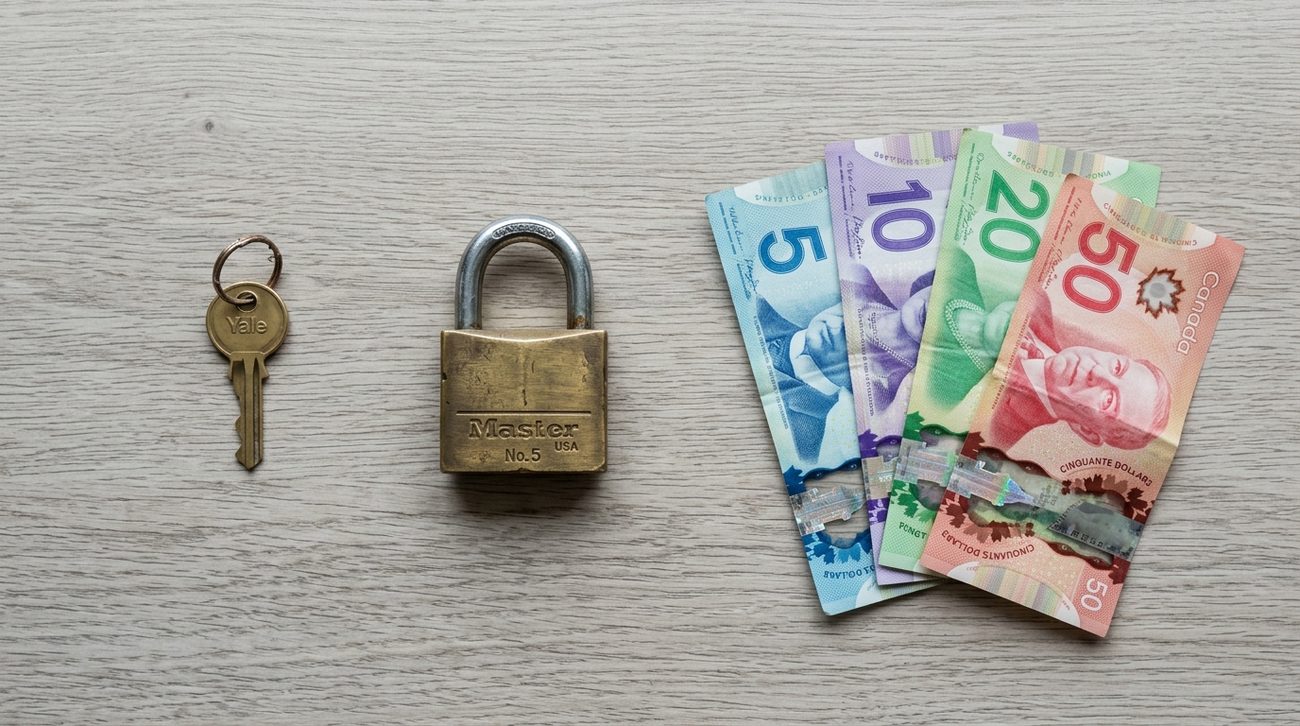
Nothing is stored in your wallet. There is no file containing bitcoin, and nothing physically moves when you send a payment.
What exists is a public ledger — a record, copied across thousands of computers, of every transaction ever made. That ledger does not track balances by person. It tracks amounts and the conditions required to spend them. Somewhere in it are entries saying, in effect, "this much bitcoin, spendable by whoever can prove they hold a particular key."
Your wallet's job is to hold that key and to prove it, on demand, without ever revealing it. That is the entire trick.
A private key is, underneath, an enormous random number. Its usefulness is that it can produce a signature: a piece of data that anyone can check, that could only have been produced by that key, and that reveals nothing about the key itself.
That last part is what makes bitcoin work. You prove you are allowed to spend without ever handing over the thing that allows it. Every payment you make is a signature saying "the holder of this key authorises this exact transaction" — and if a single detail of the transaction changes, the signature no longer matches.
Ownership of bitcoin is not a name on an account. It is the ability to produce a valid signature. Whoever can do that owns the bitcoin, and anyone who cannot does not — including you, if your bitcoin sits on an exchange and only their system can sign.
From your private key, your wallet derives a public key, and from that, an address. The derivation only runs one way: address from key is easy, key from address is impossible.
Think of an address as a padlock you can hand out freely. Anyone can snap it shut on a payment. Only your key opens it.
That one-way property is why publishing an address is safe. It is also why an address is not a wallet, not an account, and not a login — it is a destination, and one wallet can produce an effectively unlimited number of them.
If a wallet needed a separate backup for every key, self-custody would be unmanageable. It does not, because the keys are not independent.
Your twelve or twenty-four recovery words encode a single starting number: the seed. From that seed, your wallet derives every key it will ever use, in a fixed and standardised order. Key number one, key number two, key number five hundred — all reproducible, from those words, forever.
You may have noticed that asking for a receive address twice gives you two different addresses, and that the old one still works. That is deliberate.
Because the ledger is public, anyone who knows one of your addresses can see every payment it ever received. Reusing a single address builds a public, permanent record of your income in one convenient place. Using a fresh address each time scatters that information instead.
It is a privacy measure rather than a security one — an old address is not unsafe, it is just revealing. All of them belong to the same wallet, and your wallet watches all of them.
Here is the idea that surprises people most, and the one that explains the most.
The ledger does not store "you have 0.5 bitcoin." It stores individual, indivisible outputs — each one created by a specific past transaction, each with its own amount. The unspent ones are called UTXOs: unspent transaction outputs. Your balance is simply the sum of yours.
The closest everyday comparison is cash, but cash in strange denominations. If someone paid you 0.3, someone else paid you 0.15, and you bought 0.05, you do not have "0.5." You have a 0.3 note, a 0.15 note, and a 0.05 note. Your wallet adds them up and shows one number, which is a convenience, not the truth.
You cannot tear a note in half. To pay 0.1 using your 0.3 chunk, the whole chunk gets spent — 0.1 goes to the recipient and roughly 0.2 comes straight back to you as a brand-new chunk at a fresh address of your own. That returning amount is called change, and it is why your transaction history sometimes looks like you sent yourself money. You did.
Almost every piece of bitcoin behaviour that seems arbitrary at first is a direct consequence of the four ideas above.
You pay for data. Five small chunks take more space than one large one, whatever the totals are.
The whole chunk is spent and the remainder returns to you as change.
Every key is reproduced from the seed in a standard order.
Public keys can find your coins; only spending requires the private key.
Spending two chunks together publicly links them as belonging to one owner.
There is no account to credit back—only a new transaction signed by the new owner.
That fifth row is worth pursuing once the rest has settled. It is the entire basis of coin control and labelling, and it is the difference between a wallet that quietly assembles a public map of your finances and one that does not.
If those four sentences make sense, you have the model. Everything else on this site is detail hung on that frame.
This page explains how the pieces fit together rather than defining every term you will meet. For quick definitions — script types, derivation paths, mempool, PSBT, and the rest — the glossary is searchable and built for exactly that.
Start Here walks through four practical steps: create, back up, test recovery, and receive a small amount.